
Did you know that a feature less than two years old is already appearing in over half of Google searches on some devices? This is the reality of AI Overviews, the single biggest change to search since the introduction of mobile-first indexing. What started as an experiment has now fundamentally altered the relationship between search visibility and website traffic, forcing businesses and marketers to rethink their entire SEO strategy.
This guide breaks down the rapid evolution of AI Overviews, the data-backed impact on search, and the new rules for success in this AI-driven landscape.
From Experiment to Global Rollout
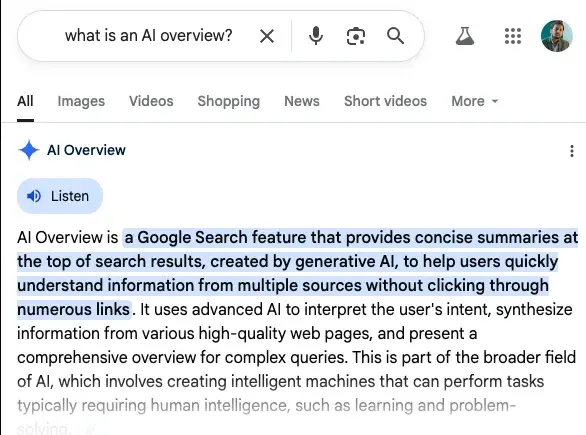
The feature now known as AI Overviews began its life as an experiment called the Search Generative Experience (SGE). First unveiled at Google I/O in May 2023, it was a bold step toward integrating generative AI directly into the search results page. Its transition from a limited test to a global standard has been astonishingly fast.
- May 2023: Google announces the SGE experiment, allowing a small group of users to test AI-powered search results.
- May 2024: The feature is officially rebranded to “AI Overviews” and begins a full-scale public rollout in the U.S.
- August 2024: The rollout expands to major international markets, including the UK, India, and Japan.
- October 2024: Google announces a massive expansion to over 100 countries.
- March 2025: The rollout is largely completed across Europe, solidifying AI Overviews as a standard search feature worldwide.
AI Overviews by the Numbers
The impact of this feature is not just anecdotal; the data reveals a dramatic shift in the search engine results page (SERP).
- SERP Domination: AI Overviews consume, on average, 42% of the screen on desktop and 48% on mobile. This pushes traditional organic results significantly further down the page, burying them “below the fold.”
- Rapid Growth: In the U.S., the percentage of search queries triggering an AI Overview jumped from 6.49% in January 2025 to 13.14% by March 2025, a 72% increase in just one month.
- Query Focus: The feature is most prominent for informational queries (questions starting with “what is,” “how to,” etc.), which trigger 88.1% of all AI Overviews.
Expert Opinion: The “Great Decoupling”
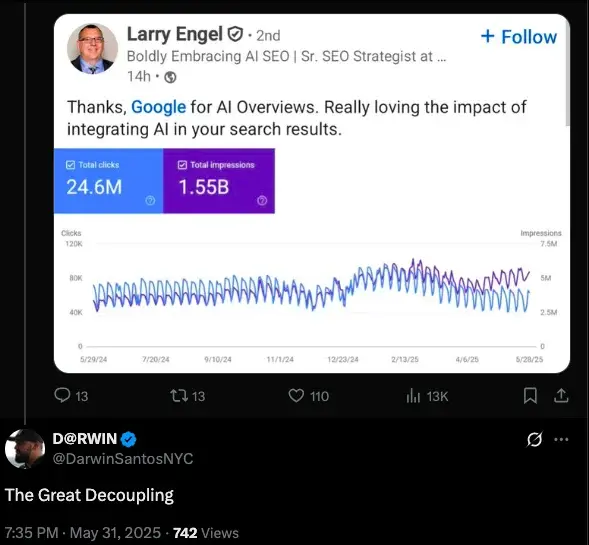
Industry experts quickly identified the core challenge presented by AI Overviews. The phenomenon was first labeled “The Great Decoupling” by Darwin Santos on X (formerly Twitter), a term since acknowledged by Google’s own team.
It describes the growing separation between search impressions (visibility) and click-through rates (traffic). A website can now be featured as a source in an AI Overview, gaining an “impression,” while receiving no direct clicks because the AI provides a comprehensive answer directly on the results page.
As one leading SEO strategist noted, “We used to tell clients that ranking in the top three was the holy grail for traffic. Now, you can be the primary source for an AI answer seen by millions but get a fraction of the clicks. The goalposts haven’t just moved; they’re in a completely different stadium.”
This shift is a primary driver of “zero-click searches” and has been shown to reduce clicks to websites by as much as 34.5% for queries where an AI Overview is present.
The SEO Shift: Then vs. Now
The rise of AI Overviews requires a fundamental change in strategy. The old playbook is no longer enough.
| SEO Focus Area | Traditional SEO (Then) | AI-Driven SEO (Now) |
|---|---|---|
| Primary Goal | Rank #1 on the SERP. | Get cited as a source in the AI Overview. |
| Key Metric | Click-Through Rate (CTR) from SERP. | Citation rate and brand visibility within the Overview. |
| Content Strategy | Target keywords and build backlinks. | Create clear, authoritative content that directly answers questions. |
| User Journey | User clicks a link to find an answer on a website. | User gets the answer directly from the AI on the SERP. |
| Visibility | Measured by organic position (1, 2, 3, etc.). | Measured by appearance in the AI summary, regardless of rank. |
How to Adapt and Win in the New Era?
While the change is significant, it doesn’t mean SEO is dead. It means the strategy must evolve. The new goal is to become the definitive source material for the AI itself.
- Embrace E-E-A-T: Focus on Expertise, Experience, Authoritativeness, and Trustworthiness. AI models are trained to prioritize information from credible sources.
- Answer Questions Directly: Structure your content to provide clear, concise answers to specific questions. Use FAQ sections, “How-To” guides, and headers that mimic user queries.
- Prioritize Clarity and Structure: Use simple language, short paragraphs, and logical formatting (like lists and tables). This makes it easier for AI to parse and synthesize your information.
- Leverage Schema Markup: Implement structured data like
FAQPageandHowToschema to explicitly tell Google what your content is about, increasing the chances of it being used.
Data shows that 76% of all citations within AI Overviews are pulled from pages already ranking in the top 10. This confirms that strong foundational SEO is still critical, but it must be paired with a new focus on becoming the AI’s preferred source.